Presidents of Pakistan
Introduction
The President of Pakistan is Head of State of Pakistan. Pakistan has a semi-presidential system of government. According to the Constitution, the President is chosen by an electoral college to serve a five-year term. The electoral college is comprised of the Senate, National Assembly and the provincial assemblies. The President may be elected but may not serve for more than two consecutive terms. The president may also be impeached and subsequently removed from office by a two-thirds vote by the Parliament. The President must also be a Muslim.
The position of President in Pakistan has traditionally been one of a figurehead, with actual powers lying with the prime minister. However, at various times in history, changes in the Constitution of Pakistan have altered the powers and privileges associated with the office of the President. The current constitution gives the President reserve powers - subject to Supreme Court approval or veto - to dissolve the National Assembly of Pakistan, triggering new elections, and thereby to dismiss the Prime Minister. The President also chairs the National Security Council and appoints the heads of the Army, Navy and Air Force.
Farooq Ahmad Khan Leghari
 Sardar Farooq Ahmad Khan Leghari was President of Pakistan from November 14, 1993 until December 2, 1997.
He was born at D. G. Khan on May 29, 1940. He comes from a family that has served as hereditary chiefs of the Leghari Tribe, and has been active in politics. His father, Nawab Muhammad Khan Leghari, and his grandfather, Nawab Jamal Khan Leghari, both were progressive leaders who introduced their Tribe to modern ideas. His father took prominent part in the Independence Movement and was confined as a political prisoner in 1946. After Independence, his father served as Minister in the Punjab Government from 1949 to 1955.
Farooq Ahmad Khan Leghari did his graduation from Aitchison College, Lahore, and earned M. A. P. P. E. from Oxford University in 1963. In the same year, he joined the Civil Service of Pakistan and worked in various fields and Secretariat positions from 1964 to 1973. He left the Civil Service in 1973 on the invitation of Prime Minister Zulfiqar Ali Bhutto to join the P. P. P. In 1975, Farooq Leghari was elected Senator. In the 1977 election, he won the National Assembly seat from his ancestral constituency in Dera Ghazi Khan and was appointed Federal Minister for Production. In 1978, he was appointed Secretary General of the P. P. P. and participated in the struggle for the restoration of democracy. He remained Secretary General till 1983 and underwent four years of imprisonment during the Martial Law. Farooq Leghari was elected member of both National and Punjab Assembly in the 1988 elections, and was appointed Federal Minister for Water and Power from December 1989 up to August 1990. In October 1990 elections, he was re-elected member of the National Assembly and became Deputy Leader of the Opposition in the Assembly.
In the caretaker Cabinet in 1993, Farooq Leghari held the portfolio of the Federal Minister for Finance. During this period he presided over the 21st Islamic Conference of Foreign Ministers held in Karachi from April 25 to 29,1993. In the October 1993 general elections, he won the National Assembly seat and was appointed Federal Foreign Minister. Farooq Ahmad Khan Leghari was elected President of Pakistan on November 13, 1993, and took oath the same day for a term of five years. In February 1997, Mian Nawaz Sharif, a major political opponent of Farooq Leghari, was elected as the Prime Minister. With the passing of the Thirteenth Amendment, a direct collision course with the Prime Minster was set. Due to the dilution of Pakistan Peoples Party's role in the assemblies, chances of Leghari's reelection as President in 1998 had also become bleak. On December 2, 1997, Farooq Leghari resigned as the President of Pakistan. Instead of leading a retired life after his resignation from the office of President, Farooq Ahmad Khan Leghari entered the political arena by forming his own political party, the Millat Party, on August 14, 1998, in Lahore. His party contested the 2002 election by joining the National Alliance. The National Alliance consisted of seven parties, which included National Peoples Party, National Awami Party, Sindh National Front, Sindh Democratic Alliance, Nizam-i-Mustafa Party, Baluchistan National Party and the Millat Party. Ghulam Mustafa Khan Jatoi led the National Alliance as the Chairman. Farooq Ahmad Khan Leghari himself contested the elections from Dera Ghazi Khan and Chicha Watni and won from both seats.
The National Alliance was however unable to secure any major
position in the elections. In the National Assembly they won 13 seats.
In the Provincial Assembly elections they won 12 seats in Sindh, 12 in
Punjab and five seats in Balochistan. They were, however, unable to
secure any seats in the N. W. F. P. Province. Despite the fact that the
Millat Party and the National Alliance were unable to secure a large
number of seats in the present elections, it is viewed that Farooq
Ahmad Khan Leghari and his Millat Party will play a key role in the new
political set up.
Rafiq Tarar
 Muhammad
Rafiq Tarar was President of Pakistan from January 1, 1998 until June
20, 2001. On January 1, 1998, Muhammad Rafiq Tarar took the oath as the
ninth President of the Islamic Republic of Pakistan. He secured an
all-time high number of votes from an electoral college, consisting of
a total membership of two Houses of Parliament and four Provincial
Legislatures. No one before him had ever received such overwhelming
support from the elected representatives of the people of Pakistan.
Muhammad
Rafiq Tarar was President of Pakistan from January 1, 1998 until June
20, 2001. On January 1, 1998, Muhammad Rafiq Tarar took the oath as the
ninth President of the Islamic Republic of Pakistan. He secured an
all-time high number of votes from an electoral college, consisting of
a total membership of two Houses of Parliament and four Provincial
Legislatures. No one before him had ever received such overwhelming
support from the elected representatives of the people of Pakistan.
Muhammad Rafiq Tarar was born on November 2, 1929, in a middle-class family of the village Pirkot in District Gujranwala, near Lahore. After graduating from Islamia College, Gujranwala, in 1949, Mr. Tarar secured his Law Degree from Law College, Lahore, in the year 1951. The same year he was enrolled as a Pleader. In October 1955, he was enrolled as an Advocate in the Lahore High Court. He established a practice in Gujranwala before rising to the position of Chairman, Punjab Labor Court in 1970. Four years later he entered the High Court and was appointed as the Chief Justice of Lahore High Court. Earlier, during his days as Judge of the Lahore High Court, he also served as member of the Pakistan Election Commission. Justice Muhammad Rafiq Tarar was elevated as a Judge of the Supreme Court in 1991, from which he retired in November 1994 on attaining the age of 65 years.
Following his retirement from the Judiciary in March 1997, Mr. Tarar moved from a legal to a political career. He was elected as member of Senate on P. M. L. (N) ticket. On December 31, 1997, he was elected as the President of Pakistan. His appointment as the President is widely attributed to his close ties with the family of the then Prime Minister of Pakistan, Mian Muhammad Nawaz Sharif. On June 20, 2001, by virtue of a Provisional Constitutional Order, he was replaced by General Pervez Musharraf, who himself became the President.
Immediately after Independence in 1947, Rafiq Tarar performed voluntary duty as a relief worker in camps set up by Muslim Students Federation for refugees, migrating from the riot-torn India to Pakistan. He has a passion for poetry and literature, with a deep insight into classic Persian Literature. He is married and has four children; three sons and a daughter. af THE (Retd)
Pervez Musharraf LEGEND
 General Pervez Musharraf (Retd) was President of the Islamic Republic of Pakistan from 2001 until 2008
General Pervez Musharraf (Retd), the second of three brothers, was born in Delhi on August 11, 1943. His parents chose to settle in Karachi after the creation of Pakistan. He comes from a middle class family, his father having worked for the foreign ministry. He spent his early years in Turkey, from 1949 to 1956, owing to his father, the late Syed Musharrafu-ud-din’s deputation in Ankara. Fluently he can converse in Turkish language and claims that Kamal Ataturk is his hero.
General Musharraf (Retd) rose to the rank of General and was appointed as the Chief of Army Staff on October 7, 1998 when Pakistan's army chief, General Jehangir Karamat, resigned two days after calling for the army to be given a key role in the country's decision-making process. General Musharraf was given additional charge of Chairman Joint Chiefs Staff Committee on April 9, 1999. On October 12, 1999, when through a bloodless coup the military took over the government in Pakistan, he became the head of the state designated as Chief Executive. He assumed the office of President of Pakistan on June 20, 2001. In order to legitimize and legalize his rule, General Pervez Musharraf held a referendum on April 30, 2002 thereby elected as President of Pakistan for duration of five years. In accordance with the deal with MMA (Muttahida Majlis-e-Amal), he agrees to leave the army on 31st December, 2004 but will continue to serve five-year term as President as he got vote of confidence on January 1, 2004, from the parliament and the four provincial assemblies under the provision of the 17th Amendment duly passed by the National Assembly and the Senate.
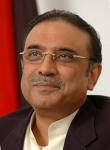
Asif Zardari is currently the president of islamic Republic of Pakistan
Asif Ali Zardari belongs to a Shia Muslim, Sindhi Baloch family from Sindh. He was born in Karachi and is the son of Hakim Ali Zardari, head of one of the Sindhi tribes, who chose urban life over rustic surroundings. His mother is from the family of Khan Bahadur Hassan Ali, who was among the founders of the first educational institution in Sindh, "Sindh Madarsa-tul-Islam Karachi".Zardari received his primary education from Karachi Grammar School and his secondary education from Cadet College, Petaro. Zardari also attended St Patrick's High School, Karachi.While a candidate for parliament, a position for which a 2002 rule requires a college degree, Zardari claimed to have graduated from a college in London called the London School of Economics and Business (LSEB).The 2002 rule was overturned by Pakistan's Supreme Court in April 2008.
Political career and corruption charges
Zardari married Benazir Bhutto on 18 December 1987. In 1988 his wife won the seat of Prime Minister, and Zardari became a member of the National Assembly of Pakistan. He served as investment and environment minister in Bhutto's governments. It was during this time that Zardari's opponents began using the nickname, "Mr 10%", in reference to the charges of corruption against him. Bhutto's government lost in the 1990 elections. Zardari soon came under investigation in Switzerland over alleged receipts of kickbacks from two Swiss-based companies. Zardari claimed the charges were political in nature, and in 2008 Switzerland closed the case and released Zardari's frozen assets. The chief prosecutor said he had no evidence to bring Zardari to trial. When Bhutto returned to office in 1993, Zardari was released from jail and became a government minister. In 1996, after a change of government, Zardari was again arrested. From 1997 to 2004, Zardari was kept in jail on various corruption charges and accusations of murder. Pakistani investigators accused Zardari and his wife Benazir for embezzling as much as US$1.5 billion from government accounts.He was also accused of allegedly plotting the murder of Murtaza Bhutto, the brother of his wife Benazir Bhutto. He was later cleared. Another allegation involved an estate in Surrey which Pakistani press speculated was purchased by Zardari. Zardari's financial history was one case study in a 1999 US Senate report on various vulnerabilities in banking procedures.A New York psychiatrist found in March 2007 that Zardari's time in jail left him with memory impairments. Zardari claims to have been tortured.When Zardari stood for the Pakistani presidency in 2008, the Pakistani Ambassador to the United States, Husain Haqqani, said that Zardari had no current mental condition requiring psychiatric help or medication.In October 2007, the president of Pakistan, Pervez Musharraf, issued the National Reconciliation Ordinance which granted amnesty to politicians in office from 1986 to 1999.
Syed Yousaf Raza Gilani 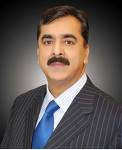
Gilani was born in Karachi on 9 June 1952 . He belongs to an influential political family from Multan. His father was a descendant of Syed Musa Pak, a spiritual figure of the Qadiri Sufism order which traces its origins to Abdul-Qadir Gilani of the Gilan province of Iran. Gilani attended Government College and obtained his B.A and M.A. in Journalism from University of the Punjab. Gilani is married and has four sons, one daughter, and one grandson.His eldest son, Syed Makhdoom Abdul Qadir Gilani, started his own political career from Multan, and in 2008 he married the granddaughter of Pir Pagara Shah Mardan Shah II, an influential political and religious leader of Sindh. His three other sons—Ali Qasim Gilani, Ali Musa Gilani and Ali Haider Gilani—are currently studying abroad. His daughter's name is Fiza Gilani.
Political career
Gilani's political journey began during General Zia-ul-Haq's martial law in 1978. He joined the Central Working Committee of the Pakistan Muslim League (PML). He was also a cabinet member in the three-year government of Prime Minister Muhammad Khan Junejo, and served as Minister of Housing and Works from April 1985 to January 1986 and as Railways Minister from January 1986 to December 1986.
After a short stint with the Muslim League, Gilani joined the Pakistan Peoples Party (PPP) in 1988. In the Benazir Bhutto government of 1988-1990, he was Minister of Tourism from March 1989 to January 1990 and Minister of Housing and Works from January 1990 to August 1990. Later, under another Bhutto government, he became Speaker of the National Assembly in October 1993, serving in that post until February 1997.
He has been elected various times as the Member of National Assembly from Multan. In the 2008 general election, he beat Pakistan Muslim League (Q) (PML-Q) leader Sikandar Hayat Bosan.
Parliament
 Parliament
(Majlis-e-Shoora) consists of the President and two Houses to be known
respectively as the National Assembly and the Senate. The number of
National Assembly seats for each Federating Unit is given below:
Parliament
(Majlis-e-Shoora) consists of the President and two Houses to be known
respectively as the National Assembly and the Senate. The number of
National Assembly seats for each Federating Unit is given below:
Under the Conduct of General Elections Order 2002, (Chief Executive’s Order No. 7 of 2002) the number of seats in the Senate, National Assembly of Pakistan and the Provincial Assemblies of Punjab, Sindh, NWFP and Balochistan was increased. In order to provide the reader with comparative information, the existing and previous strength of the Senate, National Assembly and the four Provincial Assemblies is given hereunder in tabulated forms:
|
NUMBER OF SEATS | |||||||
|
EXISTING |
PREVIOUS | ||||||
|
Province/Area |
General Seats |
Seats reserved for |
Total |
General Seats |
Ulema, Technocrats and other professionals |
Total | |
|
Women |
Technocrats and Ulema | ||||||
|
Federal Capital |
2 |
1 |
1 |
4 |
3 |
- |
3 |
|
Punjab |
14 |
4 |
4 |
22 |
14 |
5 |
19 |
|
Sindh |
14 |
4 |
4 |
22 |
14 |
5 |
19 |
|
NWFP |
14 |
4 |
4 |
22 |
14 |
5 |
19 |
|
FATAs |
8 |
- |
- |
8 |
8 |
- |
8 |
|
Balochistan |
14 |
4 |
4 |
22 |
14 |
5 |
19 |
|
Total |
66 |
17 |
17 |
100 |
67 |
20 |
87 |
|
NUMBER OF SEATS | |||||||
|
EXISTING |
PREVIOUS | ||||||
|
Province/Area |
General Seats |
Seats reserved for |
Total |
General Seats |
Seats reserved for Non Muslims | ||
|
Non Muslims |
Women | ||||||
|
Federal Capital |
2 |
10 |
- |
2 |
1 |
10 | |
|
Punjab |
148 |
35 |
183 |
115 | |||
|
Sindh |
61 |
14 |
75 |
46 | |||
|
NWFP |
35 |
8 |
43 |
26 | |||
|
FATAs |
12 |
- |
12 |
8 | |||
|
Balochistan |
14 |
3 |
17 |
11 | |||
|
Total |
272 |
10 |
60 |
332+10=342 |
207 |
207+10=217 |
|
The number of Provincial Assemblies seats for each province is given below:
PROVINCIAL SEATS
|
NUMBER OF SEATS | ||||||
|
EXISTING |
PREVIOUS | |||||
|
Province |
General Seats |
Seats reserved for |
Total |
General Seats |
Seats reserved for Non Muslims | |
|
Non Muslims |
Women | |||||
|
Punjab |
297 |
8 |
66 |
371 |
240 |
8 |
|
Sindh |
130 |
9 |
29 |
168 |
100 |
9 |
|
NWFP |
99 |
3 |
22 |
124 |
80 |
3 |
|
Balochistan |
51 |
3 |
11 |
65 |
40 |
3 |
|
Total |
577 |
23 |
128 |
728 |
460 |
460+23=483 |
